
Mount Kenya National Park
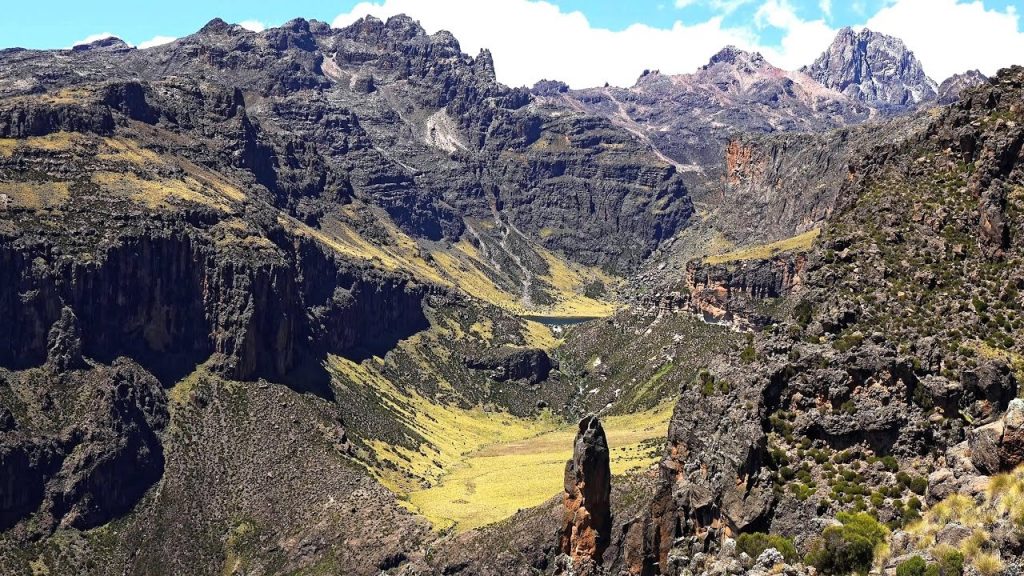
Mount Kenya National Park is located in central Kenya north of the equator and is where the second-highest peak in Africa can be found. This is also one of the biggest tourist destinations in Kenya. The different geographical features which include glaciers, U-shaped valleys and forested slopes, are part of the impressive landscape in this national park which attracts tourists to this destination.

Mount Kenya national park was a forest reserve at first before being awarded national park status in order to protect the surrounding regions, to preserve the natural environment and the water catchment area, and as well to promote tourism in Kenya. A forest reserve surrounds the national park and its history contributed to the national park status of the park.
Mount Kenya is of great importance to the people of Kenya, as it is a water catchment area that supplies water to the people living on the slopes of the mountain and also shares a name with the country, making it a major destination for the Kenyans as well as an attraction to tourists.
The six entry gates to Mount Kenya national park include Naru Moru gate, Kihari gate, Mawingu gate, Sirimon gate, Kamweti gate, and Chogoria gate. Park entry fees are cleared at the three main entry gates and proof of payment is also required for payments made prior to the visit.
The park entry fee for Mount Kenya National Park is Kshs 430 for adults.
Rules and regulations to be followed by tourists include the following:
- All visitors should enter the park with a qualified and certified guide.
- Disposable plastic water bottles are not allowed in the park.
- Guides and porters are not allowed to carry luggage that exceeds 25kg. The weighing of luggage is done at the gate upon entry.
- All visitors are required to check-in and out of the park by recording personal information in the entry and exit books.
The rules and regulations are put in place by Kenya Wildlife Services to ensure that wildlife and natural resources are conserved, protected, and sustainably managed.
Walking and hiking are the best ways to experience the beauty of Mount Kenya National Park, which can be seen along the various hiking and walking trails. The most frequented routes are found where some of the entry gates are located and they include
- Chogoria route, which is considered one of the most rewarding routes passing through forest and moorland.
- Naromoru, which is the quickest way to reach point Lenana and it offers a lookout point to see the rest of Mount Kenya national park.
- Sirimon, which is a popular point of ascent for tourists and offers a view of striking features and attractions such as Mackinder valley, Shipton’s cave.
Walking routes include Chogoria, Kamweti, Naro Moru, Burguret, Sirimon, and Timau routes, some of which require permission from Kenya Wildlife Service to use. Guides accompany climbers while sharing their knowledge about the mountain. Porters and cooks are also available during the mountain climbing experience. The porters carry most of the cooking equipment and supplies and the cooks prepare meals for the tourists. All guides and porters are registered with Kenya Wildlife Services and they are issued identification cards.
The best months for climbing in Mount Kenya national park are in January, February, August, and September during the dry season when the rocks are easier to climb in comparison to the wet seasons when the rocks are slippery and risky to climb. The climate at this tourist destination varies with altitude. The three peaks on Mount Kenya are Batian, Nelion, and Lenana.
Different tribes are seen living at the slopes of the mountain and they include the Maasai, Embu, Ameru and Kikuyu. These tribes living at the foothills of Mount Kenya also have different names for it, such as “Kirinyaga” by the Kikuyu, which translates to mean “that which has stripes.” The Maasai’s name for the mountain is “Ol donyo Keri,” which also translates to mean “mountain of stripes,” a description of the dark shades on Mount Kenya as seen from the surrounding plains.
Many beliefs are also attached to this national park, such as it being a holy ground according to the Kikuyu people, who believe that their god, known as “Ngai,” lived on the mountain peak when he came from heaven. Some of the trees found in Mount Kenya national park are of medicinal value to the local communities, such as the African pencil cedar, locally known as “Mutarakwa” in Kikuyu, which is a remedy for intestinal worms. The local communities that live around the national park play an important role in tourism as they act as guides for tourists as well as promote conservation.
Access to Mount Kenya national park can be by road or by flight as follows:
- By air/flight: Nanyuki airstrip
- By road: from Nairobi to any of the region’s main towns, which include Naro Moru, Nanyuki, Meru, and Embu.
Attractions in Mount Kenya national park
These are some of the Kenya safari activities that will quench your thirst for experiencing the Kenyan Lands.
- Mount Kenya, which is the second-highest mountain in Africa with a magnificent landscape forming part of the scenic view. Many hikers and mountain climbers visit this destination for a challenge to hike to the top of the mountain. The highest peak on this mountain is Batian peak at 5199 meters, followed by Nelion at 5188 meters and point Lenana at 4985 meters. The thrill associated with conquering the second-highest mountain in Africa makes this mountain a major attraction for tourists with an adventurous nature.
- Wildlife species found in Mount Kenya national park include white-tailed buffalo, black rhino, black-fronted duikers, leopards, giant forest hogs, bongo antelope, suni antelope, rock hyrax, black and white colobus monkeys, and albino zebras. These wildlife species are an exceptional sight during other activities within the national park.
- Bird species found in Mount Kenya national park include a red-headed parrot, bronze-napped pigeon, scaly francolin, Ayres’ hawk-eagle and many other birds, which can be spotted with the right equipment and at the right birding spots.

Activities in the park
- Hiking is a major activity carried out in Mount Kenya national park and it attracts many hikers and climbers annually, offering beautiful views during the hikes. Some of the hiking spots are for professional climbers, as they require an experienced mountain climber or hiker to reach the top of the summit, while other hiking trails are easier to climb even for a less experienced mountain climber in Mount Kenya national park. Special equipment is used during mountain climbing for safety purposes such as hiking boots. Warm clothing is also a major item to carry along during mountain climbing due to the change in altitude.
- Camping is an accommodation option during an experience at Mount Kenya national park. Many of the tourists interested in hiking and mountain climbing adventures prefer camping as a likely option to get rest as they continue their climbing adventures to the top of Mount Kenya and this provides an exceptional experience due to the scenic views that can be seen during these hikes. Huts are eco-friendly and can be booked at the park’s entrances.
- Cave exploration with caves such as Mau Mau caves, Shipton’s caves and many others being explored by the tourists. Mau Mau cave was used by the Mau Mau warriors as a place to store their supplies and also a hideout from colonialists, which makes the Mau Mau caves of great historic value. The trail to the caves offers great adventure opportunities with different scenic views such as waterfalls and rivers. This activity of cave exploration in Mount Kenya national park involves the search for ancient artifacts to learn the history and uncover mysteries about the land behind the caves.
A variety of options for accommodation are available for tourists, with some closer to the foothills of Mount Kenya and other accommodation facilities found in the nearby towns. Accommodation for tourists which provides an easier and closer location for tourists visiting Mount Kenya national park to start their adventure ranges from luxury accommodation, mid-range accommodation, and budget accommodation, and they include the following:
- Luxury accommodation: Hotel Fairmont Mount Kenya safari club, Whispers luxury guest rooms, Serena Mountain Lodge, Castle forest lodge.
- Midrange accommodation: Soames hotel & Jacks bar, Penguin house, Le Rustique.
- Budget accommodation: Batian guest house, Starbucks Katarina, Bantu mountain lodge.
Share the adventure that Kenya has to offer for a memorable and breathtaking experience by making a trip to Mount Kenya national park.