
Exploring the Hills of Mount Moroto
Mount Moroto is a popular tourist attraction located in the Northern Region of Uganda. It is an ancient volcano that rises out of the semi-arid plains of Karamoja, forming the highest mountain in the region, with the numerous peaks offering day adventures. The mountain is adjacent to the town of Moroto in the Moroto district in Karamoja northern eastern region of Uganda. It is approximately 3 kilometers (1.9 mi), by road, east of Moroto’s central business district.

Mount Moroto is one of a chain of volcanoes along Uganda’s international border with Kenya that begins with Mount Elgon in the south and includes mount Kadam and mount Morungole. The region around Mount Moroto is a forest reserve protecting a range of habitats from arid thorn savanna to dry montane forest.
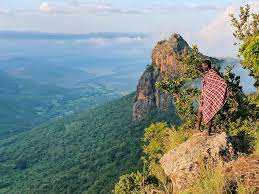
A cliff on the southwestern part of Mount Moroto, near Moroto. And it contains over 220 bird species, monkeys and wildcats the native name for this mountain was “Moru To” (meaning “the western mountain,” derived from the words “Moru,” meaning “mountain,” and “To,” meaning “west”).
It was named so because during the migration of the native tribes, who originated from Ethiopia, it appeared west. And it’s good for mountain biking.
A lot of activities can be offered while you’re in Uganda on an adventure safari to Mount Moroto, including
Mountain climbing: Climbing the rocks of Mount Moroto provides a great adventure experience in the pristine environment of one of the most challenging mountains to hike in northeastern Uganda, alongside Mount Kadam and Mount Napak, with hiking activities led by experienced local guides.
During this hike, tourists will encounter a wide variety of wildlife and have opportunities to interact with the wild species that inhabit this mountain. Travelers will also have the opportunity to discover the types of vegetation that cover the area, learn about soil fertility, interact with the botanical features, and observe how the mountain was formed by volcanic activity.
Traditionally, a mountain is a home of the mighty nomadic pastoralists who take most of their time interacting with their livestock. Mount Moroto is well known for its wide variety of minerals but most famous for the large amount of Limestone and Marble that is shipped to countries such as Italy.
The mountain is also in a good strategic location for travelers who love pictures as they continue their trip through the bushy and tall grass-covered trail. You will also come across the unique rest places where you will enjoy the sunset, the star and the sunrise over the plateau of the region.
Animal viewing; the region of Mount Moroto is a forest reserve protecting a range of habitats from arid thorn savanna to dry montane forest. The mountain is also home to wildlife, though not plentiful, such as potos, monkeys, wild cats, spectacular golden cats, and over 220 bird species.
And you will be able to spot bird species such as hornbill, tiny cisticola, red-fronted tinerbird, crested francolin, red-eyed dove, African pygmy-kingfisher, green Woodhoopoes, white-browned coucal, dideric cuckoo, augur buzzard, barn swallow, and sunbird eastern paradise, among others.
Cultural tours; this adventure is the best activity you will engage sharing and exploring the rich culture heritages of the karamajong people by participating in various cultural traditions such as traditional food and blood preparation, milking at the kraal, singing and dancing, making karamajong accessories and listening to the stories of the elders regarding their past raiding.
Bike raiding: explore the northeastern untamed pearl of Africa with the bicycle tours following the cattle footpaths of the nomad’s giants (worries) and learn pastoral culture of the community through villages and interact with the indigenous community. You can also ride over the colonial routes through Uganda’s true wilderness and get access to interact with the wildlife. Bicycle tours in the Karamoja region give you the best way to exercise yourself.
Visit the Matheniko Wildlife Reserve: Matheniko Wildlife Reserve is located in the Moroto district in the northeastern part of Uganda, in the Karamoja sub-region. It covers over an area of 1,620 square kilometers. Matheniko game reserve is home to a wide variety of wildlife and plants. The reserve is named after the Matheniko Mountain Range, which dominates almost the landscape of the area. The Matheniko Mountain Range is an important watershed that provides water to the Kidepo Valley National Park and the local community around Moroto, which is located to the north of the reserve.
Matheniko Wildlife Reserve is home to a resident wildlife haven that includes elephants, lions, leopards, hyenas, buffaloes, Uganda kobs, oribis, civets, topis, wild cats, duikers, zebras, giraffes, cheetahs , elands, Bright’s gazelles, and several species of antelope, among others.
The reserve is also home to over 200 bird species, including the Eastern Bronze-napped Pigeon, the Abyssinian Ground Hornbill, the Mountain Yellow Warbler, Verreaux’s Eagle, the Egyptian Vulture the Thick-billed Honeyguide, the Hartlaub’s Turaco, the Ethiopian swallow, the Pygmy Falcon, the Black-headed plover, the Cattle egret, the Red-billed Oxpecker and the Clapperton’s Francolin, among others.
The Ostrich, Kori bustard, Secretary bird, and various species of raptors. The largest number of primates are Patas monkeys, Baboons and Vervet monkeys. Reptiles include geckos, chameleons, Puff adders, small Lizards, Large savannah monitor Lizards, Water Snakes, and large rock Pythons among others. Many of these animals, like lesser kudu, Cheetah, Bright’s Gazelle, Elands, Mountain reedbuck, Roan antelopes, striped hyenas, topis, and Wildcats are uncommon outside Karamoja sub-region.
One of the most interesting facts about Matheniko Wildlife Reserve is its rich cultural heritage; its culture, values, and traditions remain unspoiled. The reserve is home to several ethnic communities, including the Karamajong, Tepeth Dodoth and Pokot. These communities have amazing cultural experiences that include traditional dances, songs, and storytelling. Visitors receive a fantastic experience of the cultural heritage of these communities by participating in cultural tours and interacting with the local people.
Moroto Mountain can be accessed from the Mbale-Soroti road, requiring a prominent 7-hour (170 kilometers) journey. The best time to hike Mount Moroto and other mountain ranges in Karamoja Land is in the dry season, from October to April. Nonetheless, rainy season also offers possibilities for hiking with the necessary preparations, especially on Mountain Moroto due to its rocky trails.