
A guide to visiting Mabamba swamp in Uganda: The Mabamba swamp is one of the popular destinations in Uganda which is known for being home to a variety of bird species.
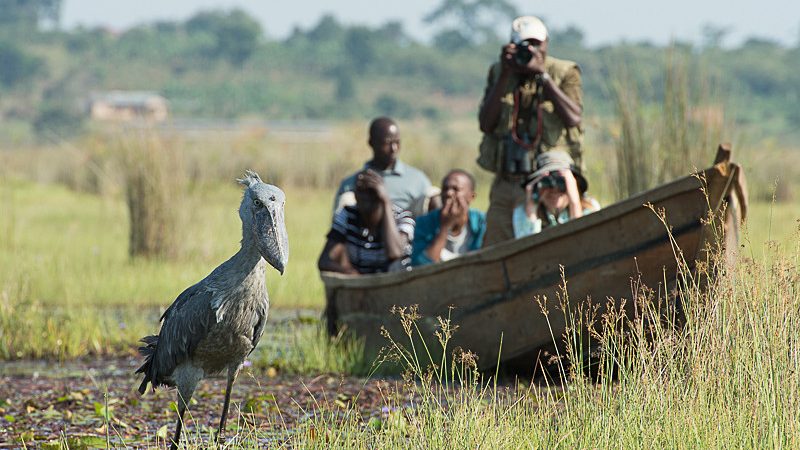
The Shoebill Stork is among the attractions found at the Mabamba wetlands which can be seen during tours in Uganda.

A guide to visiting Mabamba swamp in Uganda: About Mabamba Swamp
Mabamba Swamp is located in Entebbe on the shore of Lake Victoria and it is one of the RAMSAR sites in Uganda.
The Mabamba swamps are one of the significant birding destinations in Uganda and there are over 260 bird species which can be seen around the area.
Getting to the Mabamba swamp for the Shoebill tour can be done by boat which is operated by the locals at different times of the day. Local guides move with the tourists during their visit to the wetlands in search of the various bird species.
For those who enjoy nature and seeing different birds, bird watching in Mabamba Swamp is an amazing experience to take part in throughout the year. During the tour around the swamp, tourists get to explore the habitat of the Shoebill around the marshes as they pass through different canals which are well-known to the local guides.
Apart from bird watching, tourists can also engage in canoe rides in the morning and afternoon of Lake Victoria, visit islands on Lake Victoria, interact with the locals, and enjoy nature walks, and fishing among other experiences.
When visiting the Mabamba swamp, searching for the Shoebill Stork is one of the activities that tourists engage in and it involves canoe rides or boat rides around the swamp where different birds can also be seen.
A guide to visiting Mabamba swamp in Uganda: Shoebill tour around Mabamba swamp
The Shoebill Stork can be described as a large bird and is also known for being a pre-historic bird that is commonly sighted around wetlands areas.
The Shoebill stork is a huge bird with an 8-foot wingspan and a maximum height of 5 feet. Its general appearance is fairly similar to that of a stork, and because of this, the Shoebill was originally placed in the same order as storks but is in a similar class as pelicans and herons.
The most noticeable characteristic of Shoebill Storks is its bill, which has a wooden shoe-like shape. It’s a massive structure that ends in a curving, sharp hook. The bill has blotchy dark markings and a yellowish tint. Sharp edges on the mandibles help in catching and consuming prey.
Another feature among Shoebill storks is that they feed on fish as well as various species that live around the wetlands including Catfish, lungfish, and different species of tilapia which are among the preferred prey. These enormous birds will also consume young crocodiles, water snakes, frogs, among others.
A Shoebill Tour in Mabamba Swamp is an experience that involves exploring the habitat of the Shoebill Stork and also seeing various bird species in the marsh are well-known to local guides who can also provide transportation options to get to the wetlands and ensure a smooth and enjoyable experience while exploring Mabamba Swamp in Uganda.
The best time to engage in the Shoebill tour is during the morning hours when it is easy to see the birds as they feed around the wetlands. These tours can be private tours organized by tour operators or group tours to the wetlands with shared boats from Entebbe.
When visiting the Mabamba swamps, it is also important to consider the well-being of the birds including the Shoebill which although considered an enigmatic bird has a shy and captivating appearance therefore it is good to watch the birds from a safe distance and not disturb them to enjoy watching the birds and capturing pictures.
When visiting Uganda, other destinations where the Shoebill Stork can be seen include the Zziwa Rhino Sanctuary in Nakasongola and also in Murchison Falls National Park in the northwestern part of the country.
Other bird species to look out for when visiting the Mabamba swamp include the Blue Swallow, Pallid Harrier, Papyrus Gonolek, Swamp Flycatcher, Pigmy Goose, Lesser Jacana, White-Winged Warbler, Viellot’s weaver, Grosbeak Weaver, Black-Headed Weaver, Northern Brown-Throated Weaver, Clarke’s Weaver, Palm-Nut Vulture, And Carruthers Cisticola on the water.
How to get to Mabamba Swamp
Mabamba Swamp is roughly 57 kilometers from Kampala and one hour’s drive from Entebbe. By boat is the most convenient way to access the swamp.
To find the Shoebill Stork in the Mabamba swamp, tourists might hire a local guide. A trip to the marsh via this route is conveniently located for those who wish to see Shoebill Stork. The marsh is also accessible to visitors via road. Driving time to Mabamba Wetland via the Kisubi-Nakawuka route is two hours and from there, a boat can be taken to the wetlands.
Best time to visit Mabamba Swamp
The best time to visit Mabamba Swamp is during the dry season, which runs from June to September and December to February. During this time, the water levels in the swamp are low, making it easier to navigate the channels and marshes.
The Shoebill Stork is easiest to identify when weather conditions are also favorable, thus the dry season is also the ideal time to see it as well as various bird species which can also be seen during other months of the year including the rainy season around March to May and in November.
Where to Stay Near Mabamba Swamp
There are a variety of lodging options to choose from during tours around the Mabamba swamp and they include hotels around Entebbe or Kampala. These accommodations include budget, midrange, and luxury hotels.
Some of the accommodation facilities for tourists to choose from during their tours around the Mabamba Swamp include Nkima Forest Lodge, Aivilo Home, Cycad Entebbe Guest House, The Boma Hotel, Hotel Number 5, Admas Grand Hotel in Entebbe, Silverback Guest House Entebbe, Entebbe Backpackers limited, Hotel 7 Seasons Entebbe, Entebbe Airport View House, Papyrus guesthouse, 2 friends beach hotel, Protea hotel Entebbe among others.