
Uganda mountain hiking adventure : Hiking adventure in Uganda offers an amazing chance for adventurers to discover why this country is often called the “pearl of Africa”. With stunning, unique wildlife and rich cultural tradition. Uganda offers experiences that are hard to find elsewhere.
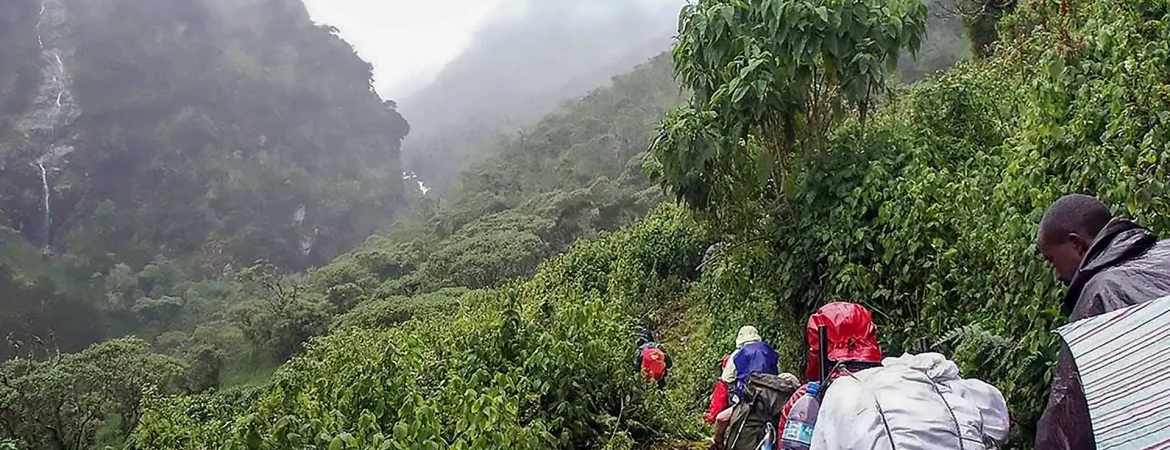
Mountain hiking adventure in Uganda are an incredible way of exploring the stunning landscapes and breathtaking scenes. The ideal places for a multi-day hike in Uganda are done in the protected areas of mount Elgon national park in Eastern Uganda. Another popular destination is the Rwenzori mountains national park know for its challenging hikes however, the country also offers half day and 1-day trips to several mountains and volcanic features such as Sipi falls, Mount Muhabura, Mount Sabinyo and Mount Gahinga. Let’s elaborate its in details;
Rwenzori Mountain Hike Safaris
Hiking in the Rwenzori Mountains of Uganda offers two main experiences: low-altitude and high-altitude treks. The low-altitude routes stay under 4,000 meters and usually last between 2 to 4 days. In contrast, high-altitude hikes take adventurers to peaks above that elevation and typically span from 4 to 12 days.
While a trek on Mount Rwenzori can be an adventure on its own, many visitors choose to combine it with other exciting safari activities in Uganda. You might explore Queen Elizabeth National Park to see wildlife, go chimp tracking in Kibale Forest National Park, or trek in Bwindi Impenetrable National Park to see mountain gorillas.
Along the trails, hikers will find standard wooden huts, constructed along the trails and each fitted with simple beds and a separate toilet hut.
The Rwenzori Mountains are home to Uganda’s tallest point, Margherita Peak, which stands at 5,109 meters on Mount Stanley. For those looking to reach this impressive summit, it’s essential to plan for at least 7 days of hiking, as the trek can be challenging but rewarding.
Hikers should be in good shape, as the best way to experience the mountain is on foot. If you’re aiming for Margherita Peak, having some technical hiking skills can be beneficial, especially when navigating the glaciers near the top.
There are two main routes to summit the Rwenzoris: The Central Circuit starting from Nyakalengija, and the Southern Circuit which begins at Kilembe. However; we recommend our guests to take the southern circuit because it provides remarkable experiences accompanied outstanding landscapes, sights and sounds of the wilderness.
As you trek deeper into this stunning mountain range, you’ll pass through various altitudinal zones, each with its own unique vegetation. You’ll encounter Afro montane plants between 1,765 and 2,600 meters, bamboo forests from 2,600 to 3,000 meters, heather at 3,000 to 3,800 meters, moorland from 3,800 to 4,500 meters, and finally, rocky glacier terrain above 4,500 meters and above.
Mount Elgon Hiking Tours
Mount Elgon offers an exhilarating hiking experience for those looking for adventure in Uganda. The mountain can be explored throughout the year and it is less crowded compared to any other travel destinations in Uganda with a milder climate and lower elevation. Hiking to the summit doesn’t require any special equipment or technical experience. So, you don’t need to be a seasoned climber or have fancy gear to enjoy the trails.
If you’re seeking a challenge, the Sasa trail is the route for you. It’s the shortest path to the summit but also the most difficult. This trek begins in Budadiri town, where you start at an elevation of 1,250 meters. Over four days, hikers cover varied terrain, including tough sections on the first day, climbing more than 1,600 meters. Along the way, you’ll pass through vibrant farming communities of the BaMasaba people and experience their rich culture. Expect stunning sights as you walk through the largest bamboo forest in the park, with a visit to Jackson’s Pool before reaching the highest point, Wagagai.
Another option is the Sipi trail, which takes between four to six days and covers a total distance of 56 kilometers. It begins at the Kapkwai Forest Exploration Centre, situated at 2,050 meters. While this trail is the longest leading to Wagagai, it offers a leisurely start. As you journey through the mountains’ northwestern slope, you’ll encounter Tutum Cave before entering the caldera. Just be prepared for a tougher trek on the third day, particularly after passing Kajeri Camp.

For a more extended adventure, consider the Piswa trail. This route spans seven days and covers about 49 kilometers, starting from Kapkwata village in the north. As you hike, you’ll navigate through the soft wood plantation to the Podocarpus forest. Encounter a number of wildlife and spectacular views of the Karamoja plains in Uganda, the Nandi and Kapeguria hills in Kenya. The Piswa trail offers a unique experience with a visit to natural hot springs as you approach both the caldera and the mountain’s peaks.
For those eager to explore more, you can organize a transboundary hike, which allows you to cross over into Kenya from the higher slopes of Mount Elgon. After hiking to the caldera with a Uganda Wildlife Authority guide, hikers can cross the border to descend with a Kenya Wildlife Service escort, making it an unforgettable experience.
Mount Sabinyo Hiking Tour
Mount Sabinyo is an extinct volcano in Uganda, located in the stunning Virunga Mountain range. This range also includes other notable peaks like Mount Muhabura and Gahinga in Uganda, as well as Karisimbi, Bisoke, and several others in Rwanda and the Democratic Republic of Congo. A small crater lake, about 20 meters wide, sits between Mount Sabinyo and Mount Muhabura, adding to the area’s beauty.
Hiking up Mount Sabinyo offers some of the most memorable experiences in Mgahinga Gorilla National Park. Before you set off on your adventure, you’ll need to check in with the park authorities. This involves registering with the park authorities, sign the guest book, later clear any required payments and receive a quick briefing about what to expect, history of the mountain and what to carry for your hiking experience.
To ensure a safe and enjoyable experience, hikers should aim to reach the summit by 3 PM. If you haven’t reached the top by then, it’s advisable to start your descent, as the trek back could become unsafe after dark.
For those carrying heavy gear, like cameras, there are porters available for hire to help lighten your load.
Packing list for a Uganda Mountain Hiking Adventure
Traveller’s planning to embark on mountain hiking adventure in Uganda are recommended to move along with right essential items for a rewarding hiking adventure. Some of the essential consideration here includes warm long walking trousers, warm long-sleeved shirts to be put on when it gets cold, warm hat and a sun hat, wool hat, waterproof and windproof jacket and trousers, rain jacket and rain pants, warmer/waterproof gloves, fleece jacket to add warmth when it gets colder, thermal underwear, mountain hiking boots, cushioned socks, lightweight walking shoes to be used at the start of the hike and crampons to be used at the summit day more so if you intend to climb mount Rwenzori.
There are also other packing essentials you should also include in your packing such as sleeping bag, backpack to keep your personal gear, head torch and batteries, water bottle to hold 3 litres per days, day bag to carry your daily water, lunch box, camera, water treatment tablets, sunglasses, lip balm, wash kit and a small towel and basic first aid kit among others
Best time to go for a Uganda Mountain Hiking Adventure
Uganda hiking adventure can be done throughout the year, but the most recommended and rewarding time to embark on a Uganda hiking adventure is during the dry season. This season normally runs from June to September and from December to February. It’s worth noting that Uganda’s weather can be quite unpredictable, so you should prepare yourself for a mix of sunny days, rain, winds and potentially muddy or foggy conditions.
The wet season, on the other hand, runs from muddy March to May and October to November. during this time, you can expect heavier rain, especially on the lower mountain slopes. Interestingly, while you might be dodging puddles at the bases, higher up on mountain, you’ll find the snow levels can increase.